

Everyone assumes hiding a file inside a photo means the photo gets bigger, or looks slightly off — a bit of noise in the sky, a colour that’s not quite right. It doesn’t have to look any different, if it’s done properly. The carrier can come out pixel-identical to the eye, with its metadata intact — everything a casual look would check. Getting there is the harder half of the problem, and it’s the half most “hide a file in a photo” tools skip.
Last week I wrote about steganalysis — the statistical side of this, where I explained exactly how naive embedding gets caught: comb patterns in pixel histograms, RS analysis asymmetry, the whole toolkit forensic analysts use to find hidden data that was never meant to be found. This week is the other side. I built snapWONDERS Vaultify, the tool for hiding a file inside a photo or video, and “hiding it well” turned out to be a genuinely ongoing engineering problem, not something you solve once and move on from.
What steganography actually is
Steganography and encryption solve different problems, and conflating them is the most common misunderstanding I run into. Encryption hides content — anyone can see there’s a locked file, they just can’t read what’s inside it without the key. Steganography hides existence — done well, there’s no visible sign a hidden payload is there at all. The carrier (a photo, in Vaultify’s case) looks like an ordinary photo, because to every casual check, it is one.
That distinction matters because the two techniques answer different threats. Encryption protects a file’s contents if it’s intercepted. Steganography protects the fact that a file is being carried at all — useful anywhere the presence of a hidden message, not just its content, is the thing at risk. The strongest approach doesn’t pick one over the other; it uses both, each doing the job the other one can’t.
Why naive embedding gets caught
Last week’s article covered this in detail from the detection side, so I won’t repeat the mechanics here — the short version is that naive tools embed the same amount of data into every pixel, uniformly, regardless of what that pixel can actually absorb without leaving a trace. That uniformity is exactly what statistical tests key on: pixel histograms comb, bit-plane randomness shifts, correlations that a real photo’s noise has naturally get broken in ways nothing natural breaks them.
Where the data actually goes
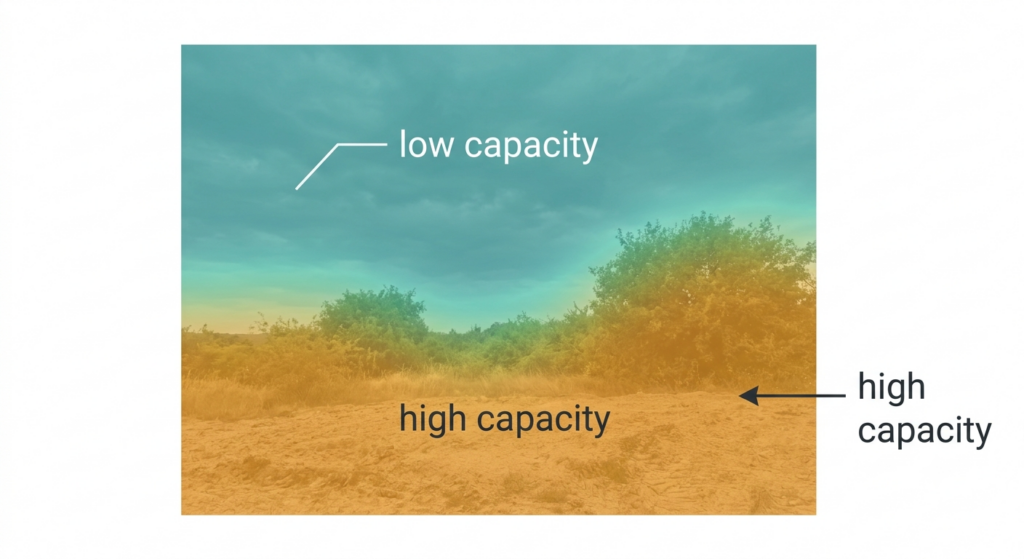
Not every part of a photo can absorb hidden data equally. A flat blue sky or a clean colour gradient shows even a single altered bit; a busy scene — foliage, fabric, a crowded street — can absorb far more before a person would ever notice. Treating every pixel the same, the way naive embedding does, ignores this completely.
Vaultify runs an AI system across every cover image that models how a person actually perceives it — which parts of the photo a human eye would register a change in, and which parts it wouldn’t — and uses that to decide how much data each region can carry. Areas where a change would stand out get little or nothing hidden in them; areas where it wouldn’t get more.
This isn’t a new idea for me. Back in 2024, before Vaultify existed, I wrote about training AI to “comprehend the visual perception of digital content by the human eye… and identify areas where information loss is negligible compared to noticeable loss” — back then, aimed at compression. It’s the same underlying principle, now built into how Vaultify decides where a hidden file actually goes: using human visual perception itself, not a fixed rule applied everywhere identically, to decide what an image can and can’t give up without showing it.
Hiding well is an ongoing problem, not a solved one
Because detection techniques keep advancing, so does the work on the hiding side — there’s no finish line where a method becomes permanently safe from every future statistical test. That’s an honest thing to say about the field generally, and it’s true of Vaultify’s own approach as much as anyone else’s: the goal is resisting casual and automated detection today, not making a permanent, unfalsifiable claim about tomorrow’s forensic research. Any product that tells you otherwise is making a promise the field itself can’t back up.
Encryption + hiding: the two-layer model
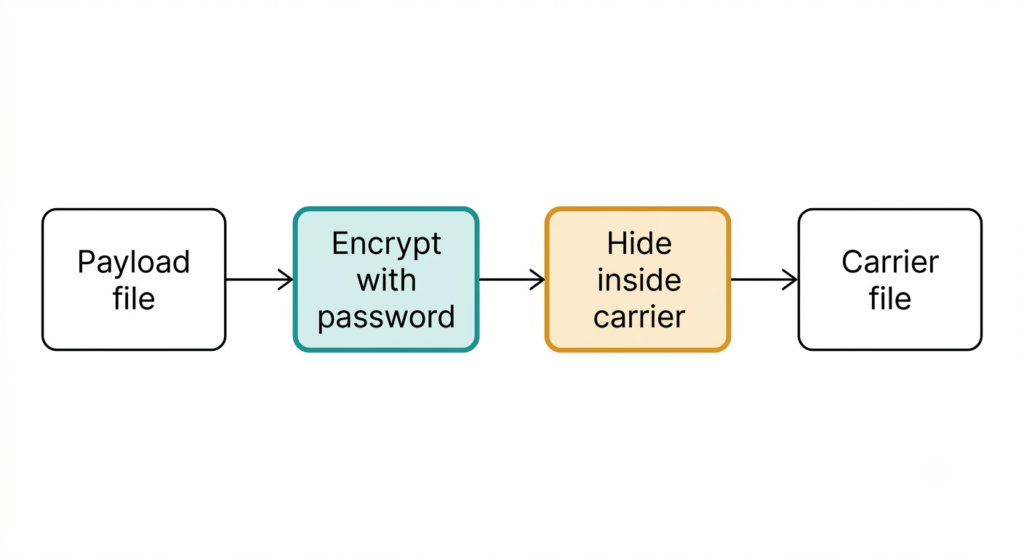
Vaultify treats hiding and encrypting as two separate, deliberate layers, not one blended step. The file you want to hide gets encrypted with a password first. Only the resulting ciphertext — not the original file — ever gets embedded into the carrier, at the depth the AI weighting decided each region could take. That ordering matters: even in the scenario where someone successfully extracts the hidden payload from the carrier without the password, what they get out is encrypted data, not the file itself.
What you can hide, and where
Vaultify accepts common photo and video formats as covers and converts them automatically to whatever the hiding process needs — you don’t have to think about the format going in. What you can hide inside them covers documents, images, and audio. The one thing that does matter is scale: a payload that’s large relative to the carrier is inherently a harder problem to hide well than a small one.
Trying it yourself
If you want to see this in practice rather than just read about it, snapWONDERS Vaultify runs the full process — weigh the image, encrypt the payload, hide it — through a straightforward upload flow, no account required.
→ Hide a file inside a photo or video with Vaultify
A photo that looks untouched isn’t proof that it is. Deciding what it can give up — and pushing that decision as far as it can honestly go — is the harder, ongoing half of the problem.
Kenneth Springer is the founder of snapWONDERS and built Vaultify, its AI steganography platform. Last week’s article covered the detection side of this same work — the statistical tests that catch naive embedding. The idea that human visual perception itself could guide what an image can give up is something he was already writing about in 2024, well before Vaultify existed. Working on both the hiding side and the detection side of steganography today means the reasoning runs in both directions. snapWONDERS Vaultify — no account required.