

On the evening of April 12, 2026, I pushed the final commit and opened a browser. A photo came out the other side carrying hidden content — invisible, encrypted, intact. It worked.
I sat with that for a moment. More than a moment.
This is the story of how we got there, and who “we” really means.

A question worth building a company around
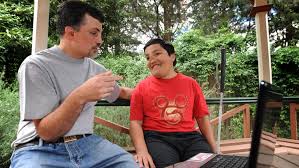
Huey lost his eyesight at four. Not gradually — the world simply stopped being visible in the way it had been. He was diagnosed, adjustments were made, life continued. By the time he was old enough to try using the web properly, he was navigating something that had never been designed with him in mind.
I watched him. Not with pity — Huey didn’t want that and didn’t need it — but with the particular attention of a software engineer watching a user encounter a system that is failing them. He wasn’t failing. The system was.
The information overload that sighted users filter almost unconsciously — visual hierarchy, whitespace, colour contrast, spatial layout — was arriving for Huey without any of that sorting. He was processing everything equally. It was exhausting in a way that shouldn’t be necessary.
He asked me, with the directness that was very Huey: why can’t the web just look the way I need it to look?
That question became a company. In 2014, we founded Hueyify together. We defined “hueyify” as a verb: the ability to transform Internet content and display it in any way possible that aids your browsing experience. The mission was never exclusively about blindness — it was about anyone for whom the web, as built, doesn’t quite work. Autism. Learning differences. Information overload. The people who need the web to be different, and find it isn’t.
Building with Huey was not a metaphor. He had specific, considered opinions about what we were making. He could describe with precision the places where existing assistive tools fell short — not in abstract terms, but in the concrete language of someone who had tried them and found them wanting. He was interested in the product logic. Interested in what “transformation” should actually mean for different types of content, different types of users. He brought a rigour to the problem that I respected and needed.
The years between 2014 and 2017 were full. Conference presentations. Media appearances. Community pitches. The kind of early-stage work that is exhausting and clarifying in equal measure. Through all of it, Huey was present — a real collaborator, not a symbol.
The venture earned real recognition. An international patent application was filed — PCT/AU2016/050860, “System and Method for Providing a Personalised Reactive Web Experience.” Hueyify was named a top 5 finalist in Australia at the Chivas Venture competition in 2016 — a global venture competition run by Chivas Regal. The following year, Hueyify was listed in the Australian anthill SMART 100.
These things mattered. Not for their own sake, but because they confirmed that the idea was real — not just a personal project, not just a father doing something to help his son, but a commercially credible venture that other people could see the value in.
The Hueyify logo was co-designed by Huey, his older sister Elleleen, and me. A ‘H’ shape, rendered in Braille, in black on yellow. Clean and purposeful, like the mission.
Around this time, Huey had a specific idea that I kept returning to. A blind person receiving a photo from a family member experiences the image differently — or not at all, depending on their condition and the tools available. But what if the photo could carry more than the image? What if it contained a narrative — the story behind the picture, embedded invisibly inside it — accessible to the intended recipient?
The idea was clear. The execution was not. To hide a meaningful payload inside an image without destroying it, you need to understand where in that image information loss matters least — which regions carry the signal, which carry noise, where the human eye will never notice a change. To do that intelligently, rather than crudely, requires the kind of machine learning and AI capability that simply didn’t exist in any accessible form at the time. These were ideas well before their moment. Huey knew what he wanted. The technology wasn’t ready to deliver it.
A moment of stillness
Huey passed away at sixteen. I announced it as plainly as I could. With much sadness and heavy heart. That was all I had. May his gentle soul rest in peace always.
What I wrote at the time — and meant — was that the vision I had for Hueyify remained, and would continue in Huey’s memory. That isn’t a marketing statement. It’s the only thing that made continuing possible.

The work continues
I initially found it impossible to continue Hueyify. I paused it. But I couldn’t let go of what we had built together, or of the direction Huey had pointed toward.
What came next was a pivot — drastic, as pivots after grief often are. I founded snapWONDERS, shifting focus from Hueyify toward a different expression of the same underlying concerns: metadata, privacy, and accessibility in digital media. Not a departure from Huey’s vision, but a different way of approaching it — one I could sustain.
The work was serious and slow. snapWONDERS has now already processed over four million jobs in its earlier form — a foundation of real-world digital media knowledge. From there the forensic capabilities deepened considerably: JPEG encoder fingerprinting using DQT hash analysis, Error Level Analysis for manipulation detection, GPS triangulation and cross-referencing, noise field analysis, metadata excavation across dozens of file formats. The kind of work that requires knowing digital media at a very low level — not just what a file claims to be, but what it actually contains, how it was made, and what traces that process left behind. And we keep pushing.
People sometimes ask what keeps a project going through a period like that. The honest answer is that the work itself kept going. There is something about a hard technical problem — one that requires real knowledge, real care, and has real stakes — that doesn’t leave you alone. Privacy matters. Authenticity in digital media matters. People deserve to know what their files contain and who can see it. That’s worth sustained attention regardless of anything else.
And there was always the knowledge that the deeper the forensic work went, the closer it was getting to something else entirely.
At some point during this period, something became clear: understanding everything a photo conceals turns out to be the exact same knowledge required to put something meaningful inside one.
Forensics asks: what is hidden here that shouldn’t be? Steganography asks: can we hide something here intentionally, invisibly, and retrieve it reliably? The answer to the second question depended entirely on being able to answer the first. They weren’t two separate problems. They were the same deep knowledge of digital media, approached from opposite directions.

April 12, 2026
Vaultify launched on April 12, 2026.
It does what Huey imagined, twelve years later. Files — any file — can be hidden invisibly inside photos and videos. The content is invisible to anyone who doesn’t know to look for it, and retrievable only by the intended recipient. Military-grade encryption. Available on the clearnet, on Tor, and on I2P — because privacy means different things to different people, and access matters regardless of where you are or what network you’re on.
Huey was quite assertive that it all made sense — and he was excited to see it happen. I think part of his confidence was that he never doubted I could make it happen. He believed I was the one to do it.
A photo from a family holiday that carries a hidden story. A message for the person who receives it, not just the image on the surface. That’s what he had in mind. That’s what Vaultify is.
If you’d like the full Hueyify history, it’s at hueyify.com/our-story. The Vaultify-specific version of this story is at vaultify.snapwonders.com/our-story. If you want to see what’s inside a photo you already have, snapWONDERS can show you. And if you want to hide something inside one, Vaultify is ready.
Huey would be twenty-three this year. The work continues.