

Earlier this month I had a lot of success defining my own agentic engineering workflow at snapWONDERS. The big change is that my AI agents can now start new agents, and end them as well. The workflows survive reboots.
These are not sub-agents hidden away inside another agent. Each one is a full session with its own tab in my IDE. I can read what it is doing and I can talk to it. When a session finishes, its tab is removed from my IDE.
The workflow started on 7 November. In the first week, over 40 agents were started by other agents, not by me.
All of it is driven by what I call Lead-Driven Synthesis. This is the next step on from my previous article, No Human in the Loop. Only AI Acting on Your Intent.
The challenging part is I am no longer overseeing one agile process but multiple. Sprints now run in just a few days.
The number goes up and down
The number itself isn’t the end. What matters to me is the process where the agents themselves grow and shrink.
When a piece of work splits, an agent starts new agents for the parts. Each one creates its own DEV ticket and the necessary documentation. It implements. It does the testing, the conformance checks, the sanity checks and the whole shebang. When it is finished, it completes the documentation, updates its DEV ticket, sends a final message up to its parent, cleans up and signs off.
There were 73 sessions in the week, and never more than 26 running at once. I don’t set the number. The work does.
One week is not a lot. It is a starting point, on existing work that we have going anyway. And I still review the work before it is committed.
The pyramid
I have found a hierarchy that works.
The agents focus only on their own small area of my intent. This keeps each agent and its AI context extremely focused.
The intent enforcers each own one feature and enforce my intent on it. They split the work into chunks that fit a few-day agile cycle. A big feature gets more agents. The agent breaking up the work decides the risk and the scope, and whether the pieces are done in parallel or in sequence.
The master coordinator is across all the intent enforcers. It looks after schedules and shared resources, sends broadcasts, and starts off each new agile intent I give it.
The levels are not fixed. Any agent can split its work again, as far down as the work needs.
When something is off, it goes up to the intent enforcer, who checks it against the blueprint. If the intent isn’t clear, it is flagged to me.
The pyramid structure, while realistically probably a bad management structure, works well for AI arrangements.
Every agent has a name
Every agent is a tab with a human name that says what it is working on, like “Feature Part C”. I talk to it by that name, and the agents message each other by name.
The agents get their own IDE window, stripped right back to maximise the screen real estate for the AI. Documents open in a separate window with a light theme, so I can tell the two apart at a glance.
The ultimate goal
The ultimate goal is for agents to follow my intent. Yet I don’t want to be watching 40 or 50 or 60 or whatever number of agents and checking that they’re following my intent. I also want to cut the cost of AI tokens, by culling the unnecessary “hey, I am stuck” or “I am blocked” messages flowing through the pyramid. A stuck agent still shows up as a yellow box on my dashboard. It just doesn’t have to escalate all the way to the master coordinator.
I understand there will be testing, checking, analysing and so on. But I have found that for the most part they are resolving issues on their own, until, of course, my intent is not met or not clear and they need to flag it.
This structure works really well for me. I can see at a glance where I am needed, and potentially where my poorly written intent is blocking things. That is where the dashboard comes in.
Kenneth’s Agent Dashboard — Live Status
I could never keep watching all of this myself. Hence the next step, which I am building now.
A script reads the register of agents and redraws the picture as things change. It will show live on my internal portal.
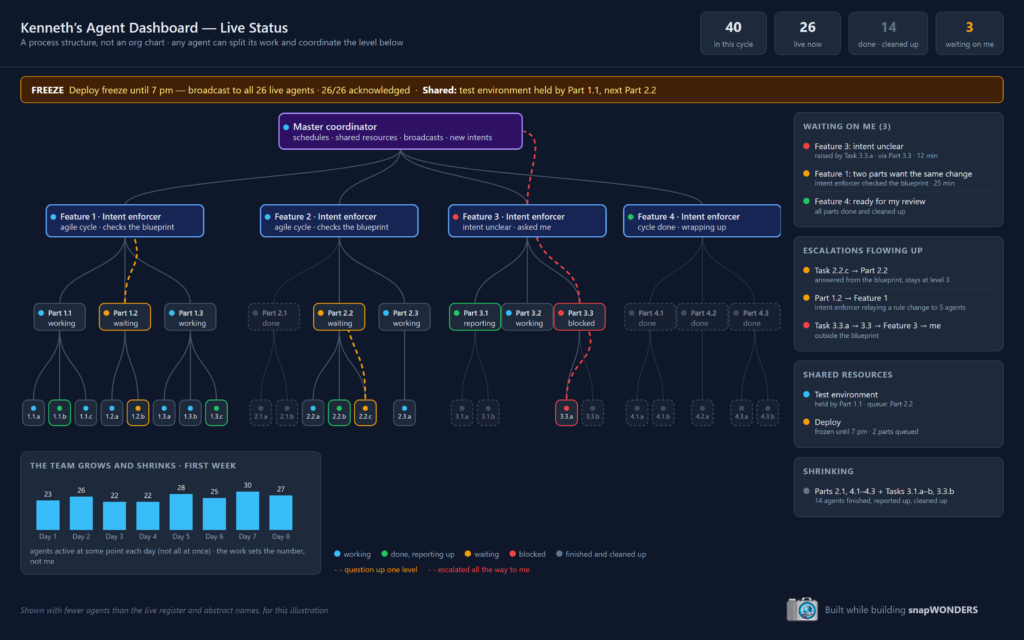
The diagram shows fewer agents than my real register and uses abstract names, for the purpose of the illustration.
I’m pretty excited to see where this goes.
Stay tuned!
May peace be with you.
Kenneth Springer is the founder of snapWONDERS, a digital forensic analysis platform for images and video. The platform is built this way: many AI agents on small pieces, one blueprint, and a person approving every change before it ships. snapWONDERS forensic analysis — no account required.