
With the rise of AI, it’s been phenomenal how much easier AI help has made generating images and videos. The tools available to a creative person now make it easier than ever to produce some pretty good digital artwork in collaboration with AI. And like all tools, they can be abused and used for wrong or questionable intents.
One way forward to mitigate this is for the content to declare itself: that it was created by AI, or by a person working with AI. That is already happening. There are three well-known ways it is done, and Google’s Gemini can put all three on the same image.
1. The visible mark: a signature you can see
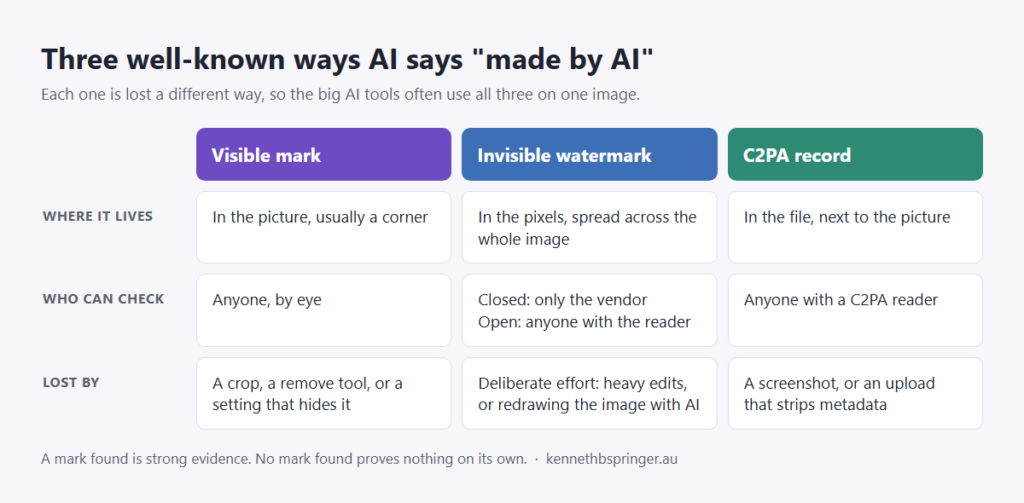
The simplest is a mark in the picture itself. Google’s Gemini app puts a small see-through sparkle in the corner of the images it makes. Other services use a logo or a text label along an edge.
It works because anyone can see it, with no software at all.
How it gets lost: a crop. Trim off the corner or edge where the mark sits and it is gone. It can also be painted out with an editing app’s remove tool, which is often AI powered itself. And since August, many Gemini users can switch the sparkle off in the app’s settings, though not on every account or in every country. Google keeps its other two signatures on the image either way.
snapWONDERS checks the corner of a photo for a known AI generator’s visible mark. When it finds one, the Watermark card at the top of the report reads “Found”, and the “Contains digital watermarks?” row says what was found.
2. The invisible watermark: a signature hidden in the pixels
The second layer is a watermark you cannot see. It is woven into the pixel values themselves and spread across the whole picture, so the image looks the same to you, while software built to look for it can still read it.
There are two kinds, and the difference matters.
Closed watermarks belong to one company. Google’s SynthID is the best known. Google adds it to images from its own AI tools, and OpenAI now adds it to ChatGPT images too. Checking is left to them: you upload a file to Google’s SynthID Detector, or to OpenAI’s verify tool for its own images, and they tell you what they found. You are taking the vendor’s word for it, because the reader is not public.
Open watermarks come from watermarking tools that vendors have published openly, so anyone can use them. An AI service, an app or a single developer can stamp images with one, and anyone running the matching reader can check for it. That openness is the point: the declaration can be verified by anyone, not just by the company that made it.
How it gets lost: with difficulty, and that is by design. A good invisible watermark is built to survive the everyday things that happen to a picture: re-saving, resizing, being sent through a messaging app, being posted to social media. It is not indestructible, though. Heavy edits weaken it, and researchers have shown that running an image back through an AI model, so it is redrawn rather than copied, can wash the watermark out (Zhao et al., NeurIPS 2024). That takes deliberate effort. It does not happen by accident.
snapWONDERS checks images, and now video, for invisible watermarks from widely available open tools. It reports that a mark is present. It does not claim to know who put it there.
3. C2PA: a signed statement attached to the file
The third layer is not in the picture at all. C2PA Content Credentials are a signed record carried in the file, saying which tool made it and, for AI tools, that it was AI generated. OpenAI and Google both add it to the images their AI tools make. I covered how it works, and what the signature does and does not prove, in Think Twice Before Claiming AI Work as Your Own.
How it gets lost: easily. Because it travels next to the picture rather than in it, anything that copies only the picture loses it. A screenshot loses it. Many upload paths that strip metadata lose it. An editor that does not support C2PA, even a perfectly honest one, can save the file without it by accident. An editor that does support it, such as Adobe Photoshop with Content Credentials turned on, keeps the record and adds its own step. So editing in the right tool rarely erases it, while the wrong tool or a simple screenshot does.
snapWONDERS reads the C2PA record when one is there and shows who signed it.
4. The lesser-known ones
Those three are the well-known ways, but they are not the only ones. A few others are worth knowing about.
A plain label in the metadata. A standard field in the file’s details can say the image was created, or edited, with generative AI. Some photo apps write it when you use an AI edit, such as removing an object. Some image generators also leave their settings or prompt as text inside the file. Both are useful when present, and both are as easy to strip as C2PA. snapWONDERS reads these too.
Watermarks that point back to the record. Sometimes called durable Content Credentials, this joins two of the layers together. A light invisible watermark carries a short ID, and the ID points to a copy of the C2PA record kept online. If a platform strips the record from the file, anyone who reads the watermark can look the record up again.
Fingerprints kept in a database. Instead of adding anything to the file, a platform stores a fingerprint of what the picture looks like, and matches later copies against it, even after every mark has been stripped. It only works for whoever holds the database, so it is not something you can check for yourself.
Watermarks in text. AI writing can carry a watermark too. The model is nudged towards a pattern of word choices that software can detect later, and Google has made its SynthID text watermarking open source. This article sticks to images and video.
Then there are the traces AI leaves without meaning to: patterns in the pixels that forensic checks can pick up after every mark is gone. Those are not a declaration, so I come back to them in section 6.
5. Why three layers, not one
Each layer covers another’s weakness. A visible mark is easy to see and easy to crop. C2PA carries the most detail and is the easiest to lose. The invisible watermark carries the least information but is the hardest to shake off. Put all three on the same image and an honest copy keeps at least one.
Regulators are pushing the same way. The EU AI Act now requires providers of generative AI to mark what their systems produce in a machine-readable way: new systems from August 2026, and those already on the market from December 2026. In practice that means watermarks and signed metadata.
6. What “no mark found” means
This is the part that matters most when you are reading a report.
A mark found is strong evidence that someone marked the file. Generator marks, watermarks and “made with AI” records do not appear in a camera photo by accident. A signed C2PA record is the strongest of them, because it cannot be forged without the signer’s key.
No mark found proves nothing on its own. The image may never have had one: plenty of AI tools add nothing, and a model someone runs on their own computer adds whatever its owner chooses, usually nothing. Or it had one and lost it along the way. That is why a forensic report never treats a missing watermark as a clean bill of health. It moves on to the evidence that cannot be cropped or screenshotted away: how the pixels were made, how the file was saved, and whether its story holds together. I wrote about those in Is This Photo Real? and How to Forensically Detect AI-Generated Images.
7. Self-declaration is a good start
AI declaring itself will not stop someone who sets out to deceive. They will crop, screenshot or regenerate. What it does is make honesty the default: images from the big AI tools now leave with a signature, and the more layers there are, the more likely one survives.
If you have an image and want to know which of these signatures it still carries, run it through snapWONDERS. The Watermark card at the top of the report, the “Contains digital watermarks?” row and the C2PA Content Credentials section show what was found, and the rest of the report covers what a missing mark cannot. For a step-by-step walk through, with real reports of a Gemini picture before and after a crop, see Does this image have an AI watermark? How to check.
Kenneth Springer is the founder of snapWONDERS, a digital forensic analysis platform for images and video. Every photo you upload is checked for the visible marks, open watermarks and C2PA records described in this article, alongside the rest of the forensic checks. snapWONDERS forensic analysis, no account required.