
Your Camera Writes Its Serial Number Into Every Photo
Turning off location isn’t enough. Many cameras write their serial number, your name and unique IDs into every photo. How to check yours and remove them.
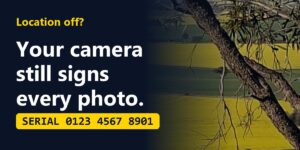
Turning off location isn’t enough. Many cameras write their serial number, your name and unique IDs into every photo. How to check yours and remove them.
A serial number is tracking. Your firmware, colour profile and time zone are a fingerprint. I tested what stripping metadata removes and what it leaves.
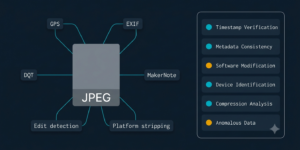
Every JPEG carries six forensic signals beyond what you see in a photo viewer. This guide covers all of them and explains what they reveal in combination.
Three methods now exist for identifying AI-generated images. Two of them fail when the creator says nothing. This article covers all three — and goes deep on the forensic signals that work regardless of what any label says.
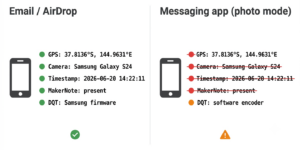
Whether you can read metadata from a received photo depends on the channel, not the tool. Email and AirDrop pass the file unchanged. Messaging apps re-encode — EXIF is gone, but a compression signature takes its place.
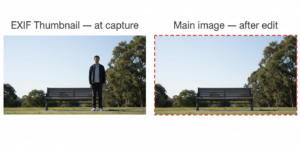
JPEG, WebP, PNG, HEIC, AVIF, and camera RAW files embed a firmware-generated thumbnail before any editing software has touched them. When software re-saves the image without updating the thumbnail, the mismatch is forensic evidence — one of 60+ forensic checks snapWONDERS runs automatically on every photo and video.
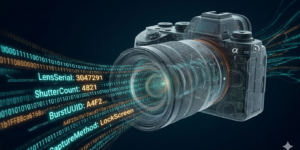
MakerNote is the manufacturer-written EXIF block that standard stripping tools typically leave intact — carrying lens serial numbers, shutter counts, burst UUIDs, and capture context that survives a standard privacy scrub. Its absence from a known device is equally revealing.
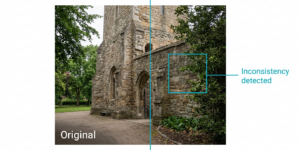
How to tell if a photo has been edited: forensic analysis reads compression signatures, manufacturer metadata baselines, and thumbnail mismatches across JPEG, WebP, PNG, and video.
Stripping EXIF metadata doesn’t make a photo anonymous. DQT quantisation tables and Huffman coding tables are baked into the JPEG compression — a permanent camera fingerprint that survives every standard metadata strip. Two of the 60+ forensic checks snapWONDERS reads from every image.

Every photo you take on your smartphone embeds a detailed record of where you were, what device you used, and exactly when — and most people have no idea how easy it is to read.

Stripping EXIF feels like the end of the problem. It is not. Metadata hides in more places than EXIF, and a photo can be identified from its own contents.
Every photo carries metadata you never see. Here is how to read it — EXIF, embedded thumbnails and the rest — on any device, with nothing to install.