

Can you tell if a photo is AI-generated without running it through another AI? Yes — and one of the six signals I use is an accounting fraud-detection law from 1938.
Wait!! Did I read that right — 1938, not 1983? What does something written in 1938 have to do with AI detection? That itself is a good question.
What Benford’s Law Has to Do With AI-Generated Photos
Benford’s Law is a genuinely fascinating statistical phenomenon: across a huge range of naturally occurring datasets, the leading digit isn’t spread evenly across 1–9. (No 0 in that range, by the way — nobody writes a number with a leading zero. 47 starts with 4, not 04, so the scale only ever runs 1 through 9).
It’s 1 about 30% of the time, and 9 less than 5% of the time. It holds for river lengths, electricity bills, stock prices, physical constants — any dataset spanning multiple orders of magnitude that wasn’t deliberately constructed. Auditors have used it for decades to catch fabricated financial figures, because humans making up numbers produce a much flatter distribution than reality does.
Why does something this simple actually work? There’s real mathematics behind it — it comes down to numbers that grow multiplicatively (through repeated scaling, not fixed steps) naturally spending more “time” sitting on leading digit 1 than on leading digit 9. You don’t need the proof to trust the pattern: it’s one of the most repeatedly verified statistical quirks in applied maths, and it shows up wherever data reflects real physical processes rather than a human — or a model — inventing numbers from scratch.
It also holds, it turns out, for the numbers hiding inside a real JPEG. When a camera sensor captures a scene and the encoder compresses it, the resulting values follow Benford’s curve closely. Images that didn’t come from that pipeline — generated pixel-by-pixel by a diffusion model, or reprocessed enough times to erase the original statistics — often don’t.
What the Check Actually Does
I run this as one of six signals in snapWONDERS’ analyse pipeline, alongside C2PA validation, wavelet noise analysis, and error level analysis (I wrote up the full set in how to forensically detect AI-generated images — this is the deep dive on the one people ask about most).
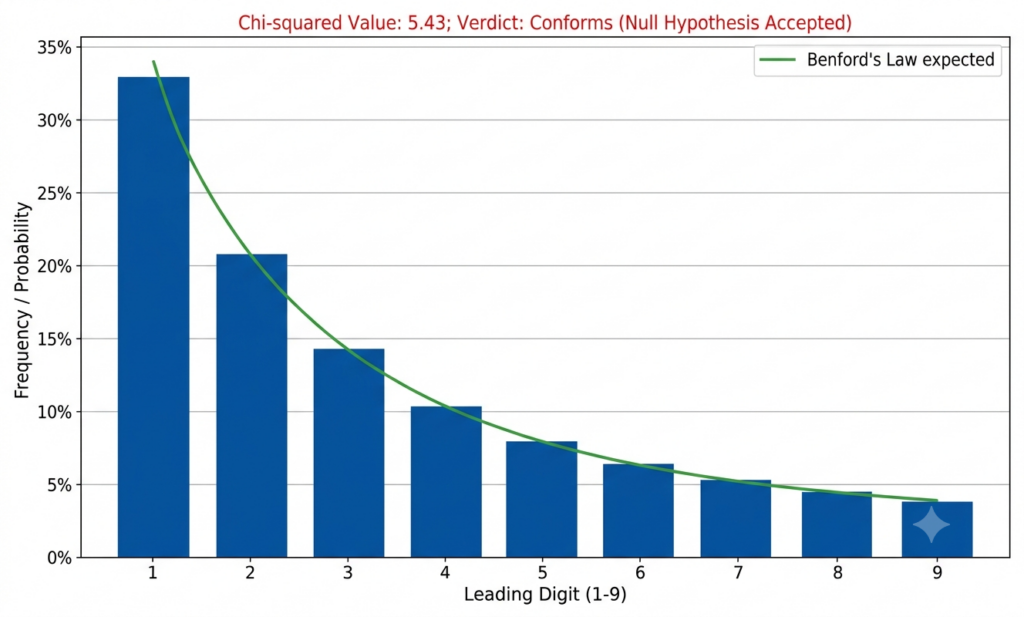
In plain terms: I chop the image into thousands of tiny tiles, convert each tile’s pattern of light and dark into a set of numbers, and look at what digit each of those numbers starts with, across the whole image. If the photo came from a real camera and a real compression pipeline, those leading digits follow Benford’s curve. If it didn’t, they tend not to.
The more precise version, for anyone who wants it: split the image into 8×8 pixel blocks and run a DCT (discrete cosine transform — the same maths JPEG compression itself is built on) on each one. That produces a set of AC coefficients per tile — numbers describing the texture and detail within it, as opposed to the single DC coefficient that just represents the tile’s average brightness (which doesn’t follow Benford, so it’s excluded). Take the absolute value of each AC coefficient, extract its leading digit, and bin them 1 through 9. Compare that distribution against the textbook Benford curve using a chi-squared goodness-of-fit test — a standard statistical way of asking “how far off is this from what we’d expect?” Above a threshold, it’s flagged as a deviation.
Where It’s Useful — and Where It Isn’t
This isn’t a standalone verdict, and I don’t treat it as one. Heavy resampling, repeated re-saving, or aggressive editing can shift an image’s statistics away from Benford’s curve too — the check can’t tell a diffusion model from a photo that’s been through five rounds of compression. That’s exactly why it’s one signal among six rather than a yes/no answer on its own; it feeds a combined score alongside checks that catch different failure modes.
What makes it worth having anyway: it costs nothing to run, needs no training data, and can’t be fooled by anything short of deliberately re-encoding a fake image to mimic real capture statistics — a much higher bar than beating a black-box classifier. On its own it’s a hint. Combined with the other five, it becomes a genuinely hard pattern to fake.
Every image run through snapWONDERS’ analyse feature gets this check automatically, as part of the same forensic pipeline behind the full JPEG forensics guide.
What still gets me, honestly, is that a piece of 1930s accounting mathematics — written decades before anyone had a digital camera, let alone a diffusion model — turns out to say something true about forensic image analysis today. I didn’t design Benford’s Law for this. I just noticed it was already sitting there in the pixels, waiting to be pointed at the right dataset. That’s the part of this work that still amazes me.
An 88-year-old fraud-detection law has no idea what a photo is — it just knows what real numbers look like, and AI-generated ones keep failing to fake it.
Kenneth Springer is the founder of snapWONDERS, a digital forensic analysis platform for images and video. The Benford’s Law check described here is one of six AI detection signals that run automatically on every image analysed through the platform, combined into a single authenticity score. snapWONDERS forensic analysis — no account required.