

There’s a claim doing the rounds that AI is going to take over — not through one dramatic leap, but by entering a continuous loop: building its own next-generation system, then the generation after that, evolving without humans in the chain at all. I sat on the fence about this for a while. I was initially skeptical. I’ve been using AI in my work since 2024, back when it was still hit-and-miss more often than not. The part that actually matters, if the takeover claim is true, is innovation — genuine novel ideas, not just faster iteration of existing concepts also true. So for the last six months I’ve been running AI hard, deliberately, against real forensic and steganography research, checking one specific thing: can it actually originate something new, or does it only work within what it’s already given?
What AI is genuinely good at: reading — not summarising
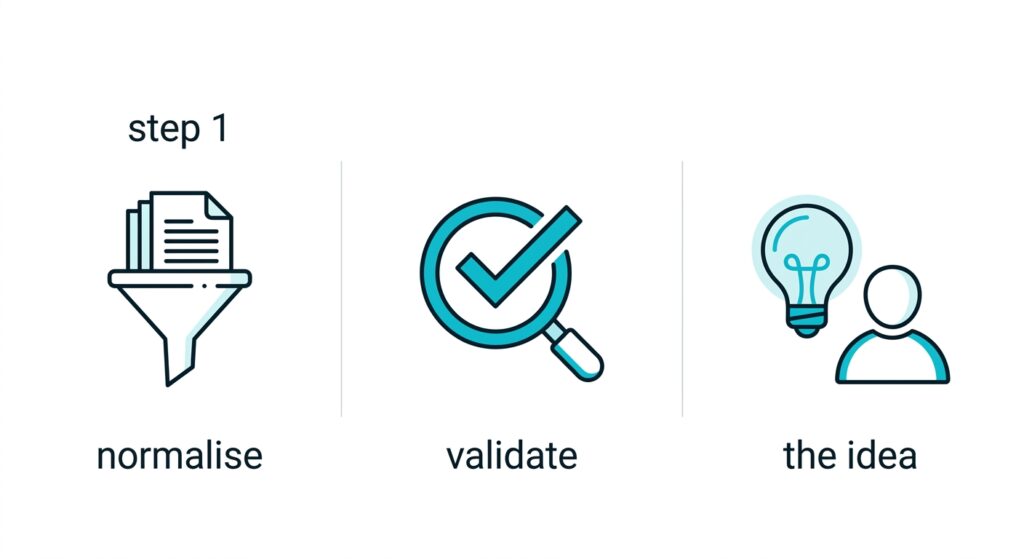
The first thing AI does well is read. I can throw in a stack of research papers plus my own research notes — the actual knowledge and expertise I’ve built up doing this work, not just scratch notes — and get back one consistent picture: same terminology, same measurement approach, no jargon drift between sources. That sounds small. It isn’t. Normalising a pile of research by hand is exactly the kind of grinding work that eats a week and produces nothing new.
I want to be specific about what that use actually looks like, because it isn’t summarising. Summarising throws information away, and reducing context down like that is dangerous when the detail is the whole point. What I actually do is work through the research iteratively with AI — asking it to explain a claim, checking that explanation against the source, cross-referencing it against other papers, pushing on anything that doesn’t hold up. That process aids comprehension. It doesn’t replace it. Once I understand a claim properly, the next step is applying it against my own data to see if it actually holds — which is the validation point below.
The catch: even done carefully, cross-referencing too hard can flatten real disagreement between papers into something that masks the subtle differences between them — and those small differences matter, because the innovation or the novelty in a piece of research often hinges on exactly that point. I check the original sources when a summary looks too clean.
What AI is genuinely good at: validation — but valid isn’t the same as useful
Second, validation. If I have a theory or an improvement, I can run it against my own data and pipeline and get a real answer, fast. Most of those results are genuinely valid. A lot of them aren’t useful. A detection-rate lift can sound significant until you look at the sample size and realise it’s too small to call, or the signal underneath it is too weak to survive contact with real data. AI is very good at telling you something is statistically true. It’s not as good at telling you whether that truth matters.
The gap: the spark is still mine
This is the one I keep coming back to. Every genuinely new direction in my research started as a hunch, not a prompt — a bit of intuition that some detail was the missing link, before I could fully explain why. When I feed that hunch to AI after the fact, it does something useful: it validates it, builds on it, and shows me the hunch was real and measurable, not wishful thinking. It has never once generated the hunch itself. It confirmed mine.
That matches a study I came across after writing this down. In 2024, over 100 NLP researchers at Stanford blind-rated research ideas from both humans and LLMs. The AI ideas scored higher on novelty. They scored lower on feasibility. When the same researchers went and actually built the ideas out the following year, most of that novelty edge disappeared. AI can generate something that reads as new on paper. Whether it holds up under real execution is a different question.
The brute-force ceiling
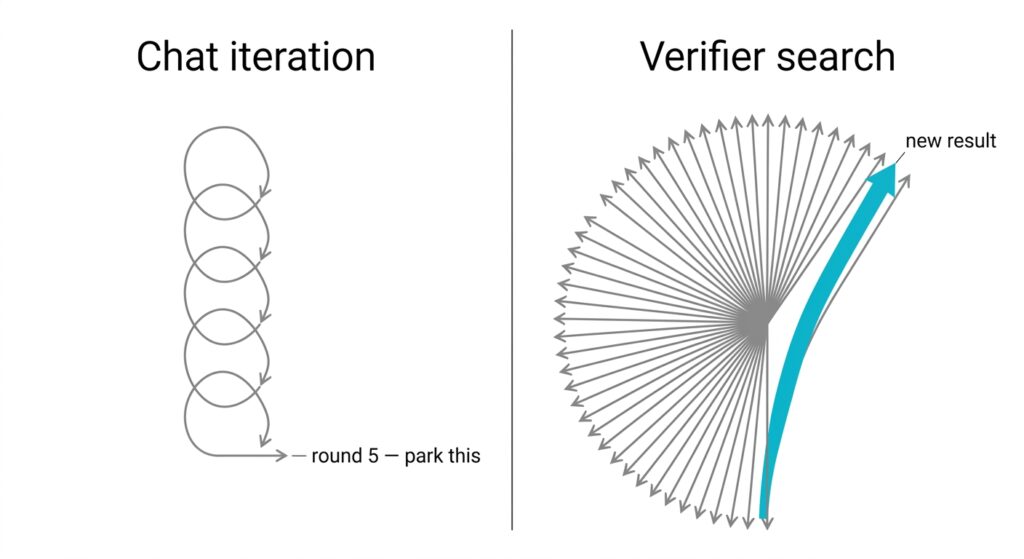
AI’s other move is brute force — trying combinations across the parameter space it already knows about. That isn’t nothing. It genuinely finds improvements. But it isn’t a novel idea, and I’ve watched it hit the same kind of ceiling more than once. By around the fifth round of iterating on a lead, the AI itself starts suggesting we park it, or, more rarely, says the lead is exhausted and further work will be wasted effort. Swapping in a more capable model doesn’t change the outcome. Same wall, same round.
I don’t think that’s really a hard AI limit. It’s more likely a property of how I was using it — one lead at a time, back and forth in a conversation. There’s research showing a similar pattern in other domains: individual outputs from AI get better, but the range of outputs across many uses gets narrower, because models trained on similar data converge on similar answers. Five rounds of chat is a very small search. It’s not surprising it runs out of room.
And that’s really the whole point of a novel idea. The moment it’s implemented and unlocked, it stops being novel. It becomes the new baseline, and the search moves on to whatever the next one is.
Where I think the fence-sitting resolves
So can AI go beyond the problem it’s handed? Not quite — and this is close to the question I keep coming back to. The real counter-evidence isn’t a smarter chatbot. It’s a different setup entirely: pair an AI with a hard verifier and let it generate thousands of candidates instead of one conversation at a time. DeepMind’s FunSearch and AlphaEvolve work this way, and they’ve produced results that aren’t in any training set — including a new algorithm for multiplying 4×4 matrices that beat a 56-year-old record.
That’s a DeepMind-scale result, though, and I run a small team. The more useful evidence for me is OpenEvolve — a separate, independent open-source project built and maintained by one engineer, Asankhaya Sharma, applying the same verifier-driven approach to its own problems. It doesn’t claim the matrix-multiplication record — that one’s DeepMind’s alone. What it does claim, in his own write-ups: a circle-packing result within 0.04% of DeepMind’s own published figure, and, in a separate piece on GPU kernel optimisation, a 12.5% average decode-speed improvement on Apple’s M-series chips, with some specific workloads gaining over 100%. Solo-scale, real results, published openly. The approach isn’t gatekept by DeepMind’s compute — it’s gatekept by whether you can write a hard verifier for your problem, which is a much more solvable problem for a small team.
The fair counterweight
I don’t want to swing too far the other way, either. A 2026 paper by Dhruv Trehan and Paras Chopra, “Why LLMs Aren’t Scientists Yet,” ran four end-to-end attempts at fully autonomous ML research using a six-agent pipeline. Three of the four failed. The failure modes they documented read like a direct description of my round-five wall: a bias toward whatever’s already in the training data, declaring success despite an obvious failure, weak judgement about which experiment is even worth running next. Structured search over a verifier is a real way past brute force. It isn’t a way past the ceiling entirely — it just moves the ceiling to a place where the human still has to decide what’s worth checking.
So where does that leave the original claim? I don’t think AI is quietly building its own successor in a loop that runs with nobody in the chain. Everything I’ve actually seen it do well — the reading, the validation, even the structured search that gets past brute force — still needs a person to define the problem first: what to search, what counts as a good result, when the problem itself needs rethinking. A loop that evolves entirely without humans would need AI to do that last part on its own. Six months in, I haven’t seen it do that once.
That leaves me with a bigger question than the one I started with.
Is a novel idea, real innovation, actually tied to imagination — the ability to dream something up, or that inkling you get when you suspect there’s a direction worth taking before it even makes sense to explain why? That feels like a genuinely human thing. Will AI ever endeavour into that space on its own terms, or will it keep covering the same ground through brute force — generating enough new-looking concepts that it eventually stumbles onto what a person would have reached by instinct? Maybe, in time. I don’t know yet.
If you’ve found a real way to get AI past brute force in a small-team setting, not a DeepMind-scale one, I’d like to hear how.
Kenneth Springer is the founder of snapWONDERS, a digital forensic analysis platform for images and video, and snapWONDERS Vaultify, its steganography tool for hiding and revealing content. The research process described here — reading, validating, and knowing when a signal’s too weak to trust — is how both actually get built. snapWONDERS forensic analysis — no account required.