

I often receive emails with questions or feature suggestions, and I appreciate every one of them. Some turn into features. Most of them teach me something about how people actually use snapWONDERS.
One question comes up more than any other. Has this photo been edited? Is this the original? And lately, with AI able to generate realistic photos and video, it has become a simpler question: is this fake?
And if it comes from someone who knows me, they’re usually doing it for fun, to test whether I can answer it correctly or not. No pressure, right?
That question has become a focal point for how people evaluate what our platform offers. It’s also getting harder to answer every month, and I want to explain why.
Can you spot an AI photo just by looking?
There is plenty of advice out there on how to spot a fake. Count the fingers. Check the teeth, the ears, the earrings. Look for writing in the background that turns into nonsense. Look for hair that melts into the shoulders.
That advice was good a couple of years ago. Early generators really did make those mistakes. But every new generation fixes the ones people talk about, because those are exactly the mistakes the people building them are working on. The odd hands, the strange omissions and the anomalies in people are disappearing.
Each generation also improves the content itself: faces, skin, lighting, shadows, even the reflections in people’s eyes. So a machine checking whether a face looks realistic is chasing the same moving target as our eyes.
I would argue that spotting a good AI photo by eye is already close to impossible, and it gets less likely with every release. If someone claims they can always tell, they are probably only noticing the bad ones.
How detection actually works
Forensically speaking, detecting AI content takes training. You need samples of real content and samples of generated content, and you compare the two until you find what separates them. A detector can only recognise what it has been shown.
This kind of training has far surpassed anything we can teach a person. Our eyes only notice so many changes, and we can only remember so much of what we’ve seen. A detector can compare every pixel in a photo, and learn from more examples than anyone could look at in a lifetime. That’s why the eyeball test is falling behind and trained detection is not, at least for generators it has seen.
That works well for generators that are known and widely used. There are plenty of samples to learn from. There are also checks that don’t need a trained model at all, such as the statistics of the compression itself, which I wrote about in Benford’s Law: Detecting AI-Generated Images Without AI. Those help, but they have limits too.
All of that is about the picture itself: the pixels, and the fingerprint a generator leaves in them. The file around the picture is a separate line of evidence. That’s the metadata, how the file was saved, and whether it carries what a real camera or phone would write.
That gives you two ways in. You can try to prove a photo is AI, or you can try to prove it’s real. The second one often tells you more. If a file claims to be straight off a phone but doesn’t carry what that phone writes, it isn’t the original it claims to be. Something else made it or changed it. It might be AI-generated, edited or manipulated, but either way it isn’t what you were told. A screenshot or a social media copy loses that evidence too, which is why the original file matters so much (more on that below).
An arms race the detectors are losing
The money going into AI is enormous. Stanford’s 2025 AI Index put corporate investment in AI at US$252.3 billion in 2024, with US$33.9 billion of private investment going to generative AI alone. Making generated images and video look real is part of that. It’s worth spelling out what it actually costs to build a model, because it explains why detection struggles to keep up.
Training one image generator. When Stable Diffusion came out in 2022, its founder estimated the computing to train it at about US$600,000: 256 GPUs and around 150,000 GPU-hours. He put OpenAI’s DALL-E 2 at roughly a million GPU-hours, more than six times as much. That was for one training run of an early model.
The biggest models. At the top end, Stanford’s 2024 AI Index estimated the computing alone to train one model at US$78 million for GPT-4 and US$191 million for Google’s Gemini Ultra. Those are language models, but they run on the same kind of hardware.
The whole bill. A training run is only part of the cost. In the same year it released Stable Diffusion, Stability AI’s operations and cloud spending reportedly passed US$50 million. Epoch AI’s breakdown of building a frontier model shows where that kind of money goes.
The hardware. Roughly half to two-thirds of the cost, in Epoch AI’s breakdown. A single top-end AI GPU costs tens of thousands of dollars, and training a leading model takes thousands of them, running around the clock for weeks or months. On top of that is the power to run them, the cooling to stop them overheating, and the data centre they sit in.
The people. Most of the rest, around 29 to 49 percent. Teams of researchers and engineers, some of the highest paid in the industry, design the model, collect and clean the training data, and run experiment after experiment. Most of those experiments fail, and every one of them still uses the hardware.
Their own build. Each company builds its own model rather than reusing someone else’s, so all of that cost gets paid again by every company in the race. Then add the offices and overheads that any large company carries.
And again. Every new version means another round of all of it.
Compare that with detection. The deepfake-detection startups I could find raising money in 2025 raised rounds in the tens of millions, for example US$16.2 million and US$13 million. That is real money, but it is a rounding error next to what goes into the generators.
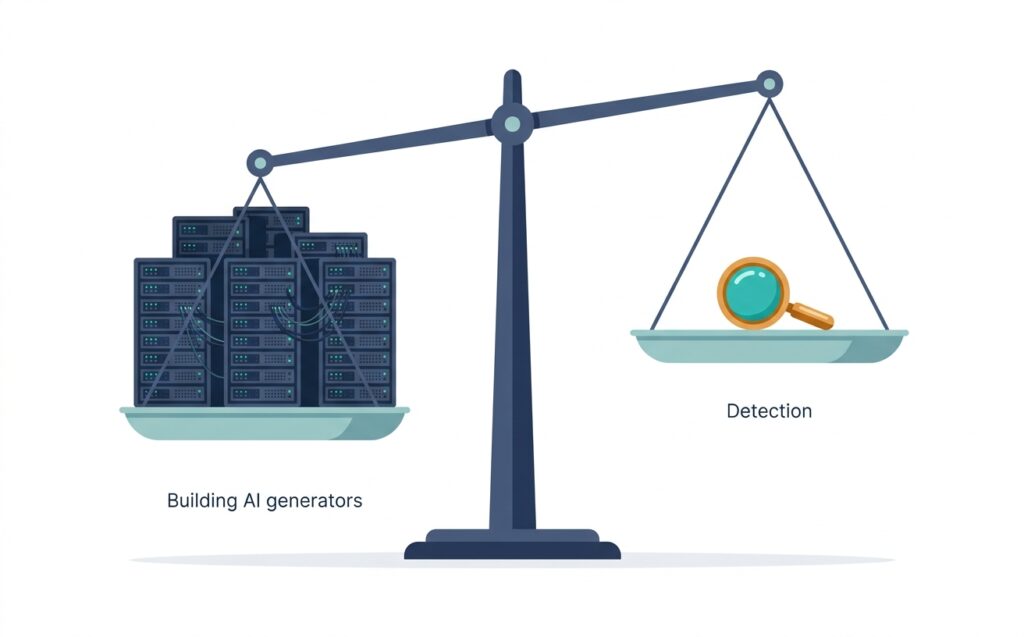
Once a model is built, though, using it is cheap. We made our new explainer video with AI partly to see how realistic it could get and how far it has come. Every model we used was free and open-licensed, the kind anyone can download and use today. It ran on one GPU in about five hours for under A$10 here in Australia, which is about US$6.50. That’s the imbalance. Building a generator costs a fortune, using one costs almost nothing, and the results are available to everyone.
Detectors also start behind. A new generator comes out, people start using it, and only then can anyone collect samples and learn what it leaves behind. By the time a detector catches up, the next version is out. Each release partly resets the race.
We work on this at snapWONDERS, so I’ll be upfront: it is getting harder, not easier.
I fear there will probably come a time when we cannot spot the fakes at all. It will be when AI learns the simple laws of nature, like the idea that beauty is often found in imperfection. Real life is full of small flaws that never repeat in quite the same way. When a generator can find that balance, making something imperfect that isn’t repeatable, it will be very hard to tell apart from the real thing.
The real risk: a generator nobody knows about
The public generators are not what worries me most. The bigger risk is an undisclosed generator. Someone builds or tunes their own, keeps it private, and only a very select few images ever get released.
There is nothing to train on. No detector has seen its output, and nobody has had the chance to learn its habits. Judging those images by eye alone would be near impossible.
It gets harder still if the generator also fakes where the picture came from. It could write the metadata and the fingerprint of a real camera or phone, so the file passes as an original. For cameras that don’t protect their output, that can be imitated.
Camera manufacturers are combating this. More of them now fingerprint what their cameras produce with their own digital signatures and watermarks, built into the hardware. Leica’s M11-P was one of the first, in 2023, and some newer phones do it too. To imitate that, a generator would have to crack how that protection works, which is a far harder problem than copying a few lines of metadata.
To be fair, a generator good enough to worry about costs the kind of money in the section above. Whoever is funding one is a serious organisation, and you would hope it has some sense of responsibility and is doing this for the greater good. That means labelling what it makes, signing it so it can be traced, and sharing samples with the people working on detection. Some of the big public generators already do parts of this.
I hope that holds. But we can’t rely on it, which is why the checks below matter.
What still works
Ask for the original file. Most of the evidence in a photo lives in the file itself: the device that took it, when it was taken, and what has saved it since. Every screenshot, forward and social media upload throws some of that away. A copy that has been passed around three times can look perfect and have almost nothing left to check.
Look for provenance. More AI tools and cameras now sign what they create. I covered what those signatures can and can’t prove in What C2PA Content Credentials Prove.
Check the file’s story against the one you’ve been told. No tool can tell you with certainty that a photo is real. What a forensic check can do is show you where the two don’t match. A photo dated before the event it shows. A “straight off my phone” picture that was last saved by editing software. That’s usually where the answer is. And when the evidence is thin, a good check says so. Our forensic report will call it inconclusive rather than guess.
The guides
We’ve put together a set of plain-English guides on snapWONDERS. Each one starts from the question people actually ask and walks through what to check, using real photos we took ourselves.
- Is this photo real, fake or AI-generated?
- Is this video real or AI?
- Has this photo been edited?
- Where did this video come from?
- Is this receipt, screenshot or certificate fake?
- Can a photo be tracked back to you?
They’re all grouped at snapwonders.com/guides.
Keep the questions coming. They’re how these guides got written.
Kenneth Springer is the founder of snapWONDERS, a digital forensic analysis platform for images and video, built and run in Victoria, Australia. snapWONDERS forensic analysis needs no account.